Examples of Publication and Writing Experience
A full bibliography of Jeff's research and natural history publications and presentations is available. This page highlights several environmental documents, and describes various other work products.
Research Guides and Procedures
- Jug Bay fish survey protocol formalizing the techniques used for long-term monitoring of stream, river, and pond fish diversity and abundance.
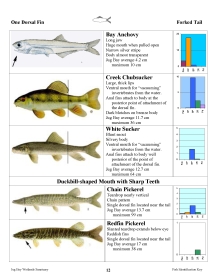
- The Fish of Jug Bay Patuxent River, Maryland: A Pictorial Key is discussed on the Maryland Nature - Fresh Water Fish page
- Vernal pool research protocol for a very large pool is discussed on the Maryland Nature - Vernal Pool Protocol page.
- Numerous detailed protocols for evaluation studies investigating the usability of various information systems. Results of those studies are included in multiple publications.
Documents written as a contractor at NOAA
Data Management Plan
The first detailed program-level Data Management Plan written at NOAA:
- The first volume, the Data Management Plan, provides specific recommendations for policies and procedures to better manage the program's environmental and scientific data.
- The second volume, the Data Management Report, includes the supporting details such as a review of the Federal requirements, an evaluation of the current data management practices, identification of relevant best practices, and recommendations.
- The third volume, is a Data Management Plan template, that distills the requirements so that they can be easily used by the specific research projects and offices.
Calibration & Validation for a New Weather Satellite
A management-level summary of how the various products (images and interpreted results) will be compared to products from other satellites and surface observations to demonstrate that the new algorithms for processing the raw satellite data are correct and consistent. The report also provides management with information about seasonal dependencies for calibration/validation such as snow coverage in winter and tropical storms in summer/autumn. Dependencies on other satellites are also emphasized since some of the current satellites may no longer be operational by the time the new satellite is launched.
Other Research
Wind Climatology
A formal review of prior analysis of off-shore wind speed derived from synthetic apperture radar (SAR) images.
Human-Computer Interaction
Academic journal and conference papers including collaborative remote writing and diagram development, GIS innovations, instant messaging, navigation, and analysis are included in the Jeff's bibliography.
Research Grants
Jeff's grant proposals have focused on research in human-computer interaction, primarily from the National Science Foundation. These programs are highly competitive. For example, in 2002, when his proposal for a Research Experiences for Undergraduates Site in Human-Computer Interaction was funded ($283,000), only 15% of proposals submitted for that program were successful in obtaining a grant. Jeff also received a Summer Faculty Fellowship in 2000 from UMBC.
Jeff has also written various research proposals for citizen science, aquatic invasive species, collaborative usage of GIS software, and environmental databases.
Other Proposals
Jeff has an established track record of writing technical and management sections of winning proposals to Federal Agencies (primarily NOAA and NASA) while working at the headquarters of a government contractor. Jeff's scientific and IT expertise has been beneficial for these proposals to support environmental research and analysis with information technology.